🎬 Who we are
The BECTU Locations Branch represents freelance location professionals working across film, TV, and commercials in the UK. Our members include location managers, assistants, scouts, unit managers and even marshals - the crew who keep productions moving — from the first visit to the final wrap.
Joining the branch means backing yourself and backing your department.
Whether you’re new to the industry or a seasoned pro, being part of the Locations Branch gives you access to support, resources, training, and a collective voice fighting for fairer working conditions.
Other branches of BECTU — like Grip, Camera, and Lighting — have become powerful forces on set. Their collective strength shapes how productions are run. We deserve that same influence. But we only get it if we stand together.
The more of us there are, the louder we are — and the harder we are to ignore.
🧱What the committee Does
The branch committee is made up of working location crew who volunteer their time to support members and push for industry change.
We take action by:
Negotiating with employers and producers to shape fair agreements
Raising concerns about hours, safety, rates, and respect on set
Organising training and education to help members up-skill and stay informed
Working with other BECTU branches to amplify our voice across departments
Guiding new members into the industry with honest advice and resources
Organise Events that members and non-members are welcome to join.
If you’re a member and want to get involved, we’d love to hear from you.
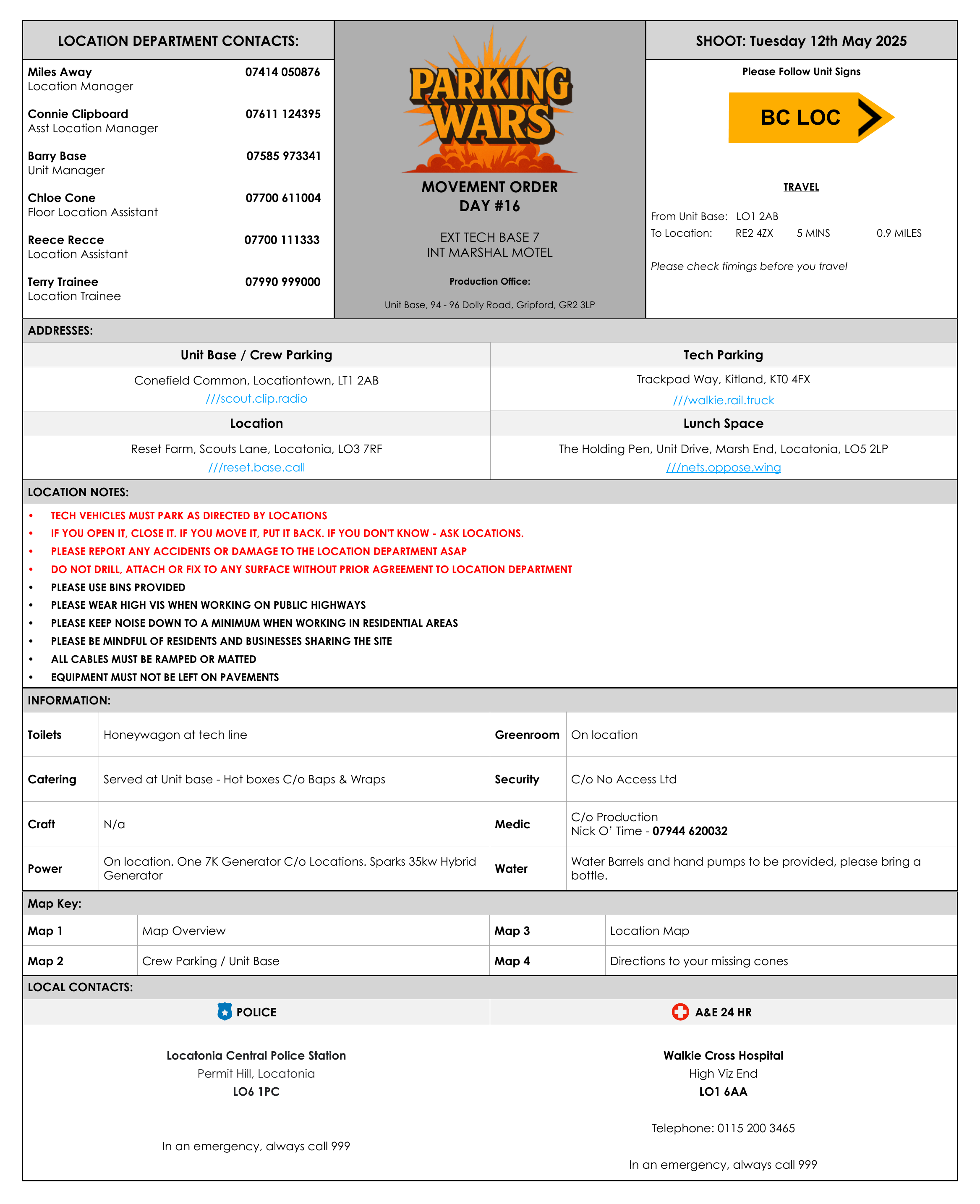
This is a mock Movement Order - Visit the ‘What’s an MO’ page for more info.
🎓 What is the Locations Department?
The locations department is responsible for all real-world spaces used in filming — sourcing them, securing them, prepping them, managing them, protecting them, and reinstating them once the cameras move on. We keep productions running smoothly, safely, and in line with local authority rules and community expectations.
Keen for even more info or looking to step up but not sure what it might entail? Check out the ScreenSkills checklist page for in depth detail on each role.
See below for what each role does in a Location Department:
-
Supervising Location Manager (SLM)
The Supervising Location Manager leads the entire locations department on large-scale productions, such as high-end TV dramas and feature films. They are responsible for overseeing all aspects of location management, from initial scouting to final wrap, ensuring that each location aligns with the creative vision and logistical requirements of the production.
Key Responsibilities:
Creative Collaboration: Work closely with directors, production designers, and other creative heads to identify and secure locations that fulfill the script’s narrative and aesthetic needs.
Team Leadership: Assemble and manage a team of location professionals, including Location Managers, Assistant Location Managers, Unit Managers, and Location Assistants, ensuring clear communication and efficient workflow across departments.
Budget Management: Develop and oversee the locations budget, negotiating fees, managing expenditures, and ensuring cost-effective solutions without compromising on quality.
Problem-Solving: Address and resolve any issues that arise during pre-production and shooting, adapting to changes and ensuring minimal disruption to the production schedule.
Ideal for:
Senior Location Managers or LMs with extensive experience, excellent leadership skills, and the ability to balance creative, logistical, and financial demands. Best suited to those ready to take strategic responsibility on large or complex shoots.
-
Overview:
The Location Manager is responsible for identifying, securing, and managing locations that align with the creative vision of the production while meeting logistical and budgetary requirements.
Key Responsibilities:
Location Scouting: Research and assess potential locations, considering creative and practical factors.
Negotiations: Secure agreements with location owners, obtain necessary permits, and ensure compliance with regulations.
Logistical Planning: Organize parking, access, and facilities for cast and crew; liaise with local authorities and residents.
Team Management: Supervise the locations team, delegate tasks, and oversee the department’s budget and schedule.
Ideal for:
Professionals with experience in location department who are ready to take responsibility for managing people, logistics, and negotiations. Great for those who enjoy problem-solving and dealing with both creative and logistical challenges.
-
Overview:
The Location Scout is tasked with finding suitable locations that fulfill the creative and logistical requirements of the production, often serving as the first point of contact with potential sites.
Key Responsibilities:
Research: Analyze scripts to determine location needs and conduct thorough research to identify options.
Scouting: Visit and photograph potential locations, assessing their suitability and noting any logistical considerations.
Reporting: Present findings to the LM and creative team, providing detailed information and recommendations.
Ideal for:
Visually driven, independent workers with a strong sense of storytelling and an eye for practical detail. Great for those who love being on the road, exploring, and taking initiative.
-
Overview:
The Assistant Location Manager supports the LM in all aspects of location management, from initial scouting to on-set coordination, ensuring that each location meets the production’s needs.
Key Responsibilities:
Scouting Assistance: Assist in researching and photographing potential locations.
Permit Acquisition: Help identify required permissions and licenses for location use.
On-Set Management: Coordinate logistics during filming, including security, facilities, and crew support.
Reinstatement: Aid in returning locations to their original state and handling any necessary follow-up with location owners.
Ideal for:
Those with some set experience and a solid understanding of location logistics who are ready to take on more responsibility. Ideal for organised multitaskers who enjoy both office prep and on-set work.
-
Overview:
The Unit Manager oversees the setup and operation of the unit base, ensuring that all logistical needs are met for the cast and crew during production.
Key Responsibilities:
Unit Base Setup: Secure suitable unit base locations, arrange necessary facilities, and coordinate with the Facilities Captain.
Logistics Coordination: Manage parking, waste disposal, power supply, and other essential services.
Budget Management: Monitor expenditures related to the unit base and ensure cost-effective operations.
On-Set Support: Help with the parking of technical vehicles on location as well as the movement of towable equipment.
Ideal for:
Logistically minded individuals who can manage people, vehicles, and equipment under pressure. Excellent for those who’ve previously worked in crew logistics, transport, or site operations.
-
Overview:
The Location Coordinator is pivotal in managing the administrative and logistical aspects of the locations department. They ensure smooth communication between various stakeholders and maintain meticulous records of all location-related activities. Normally a position found on higher budget productions.
Key Responsibilities:
Documentation Management: Create, coordinate, and store essential documents, including location agreements, permits, insurance claims, and movement orders.
Budget Oversight: Monitor and reconcile location budgets, track expenditures, and process payments.
Crew Coordination: Identify staffing needs, liaise with suppliers, and ensure the provision of necessary equipment and services.
Communication: Establish efficient communication systems, disseminate updates, and maintain records of production progress.
Ideal for:
Highly organised individuals with strong admin skills and attention to detail. This is a great step for those moving up from Location Assistant roles or transitioning into locations from production coordination.
-
Overview:
Location Assistants support the locations team in various tasks, contributing to the preparation, maintenance, and wrap-up of filming locations.
Key Responsibilities:
Preparation: Assist in setting up locations, including laying floor protection and setting up facilities.
On-Set Support: Help manage logistics during filming, such as directing crew, handling equipment, and maintaining cleanliness.
Post-Production: Aid in restoring locations to their original condition and handling any necessary follow-up tasks.
Ideal for:
Crew with on-set experience who want to build a career in locations. Great for practical, adaptable people who don’t mind being the first in and last out — and are ready to learn the ropes.
-
Overview:
Location Marshal is the most common entry point into the locations department. It’s a runner-style position that focuses on practical support during filming — whether that’s keeping the public back from shot, managing pedestrian access, or assisting with set up of equipment.
It’s often the first step into the industry for many crew, offering on-the-ground experience and a chance to learn how a set operates.
Key Responsibilities:
Support lock-ups and ensure pedestrians don’t walk through shot
Set up EZ-UPs, chairs, tables, lights and other location equipment.
Assist with prep and strike of locations, making sure shoot crews have what they need on the day.
Maintain site safety and tidiness
Ideal for:
People looking for a first job in film and TV. No experience is required — just a positive attitude, punctuality, willingness to learn, and comfort working outdoors in all weather. A great stepping stone to becoming a trainee or assistant in the department.
Contact us
Interested in getting involved, raising an issue, or suggesting something for the branch? Send us a message and we will get back to you as soon as we can.